
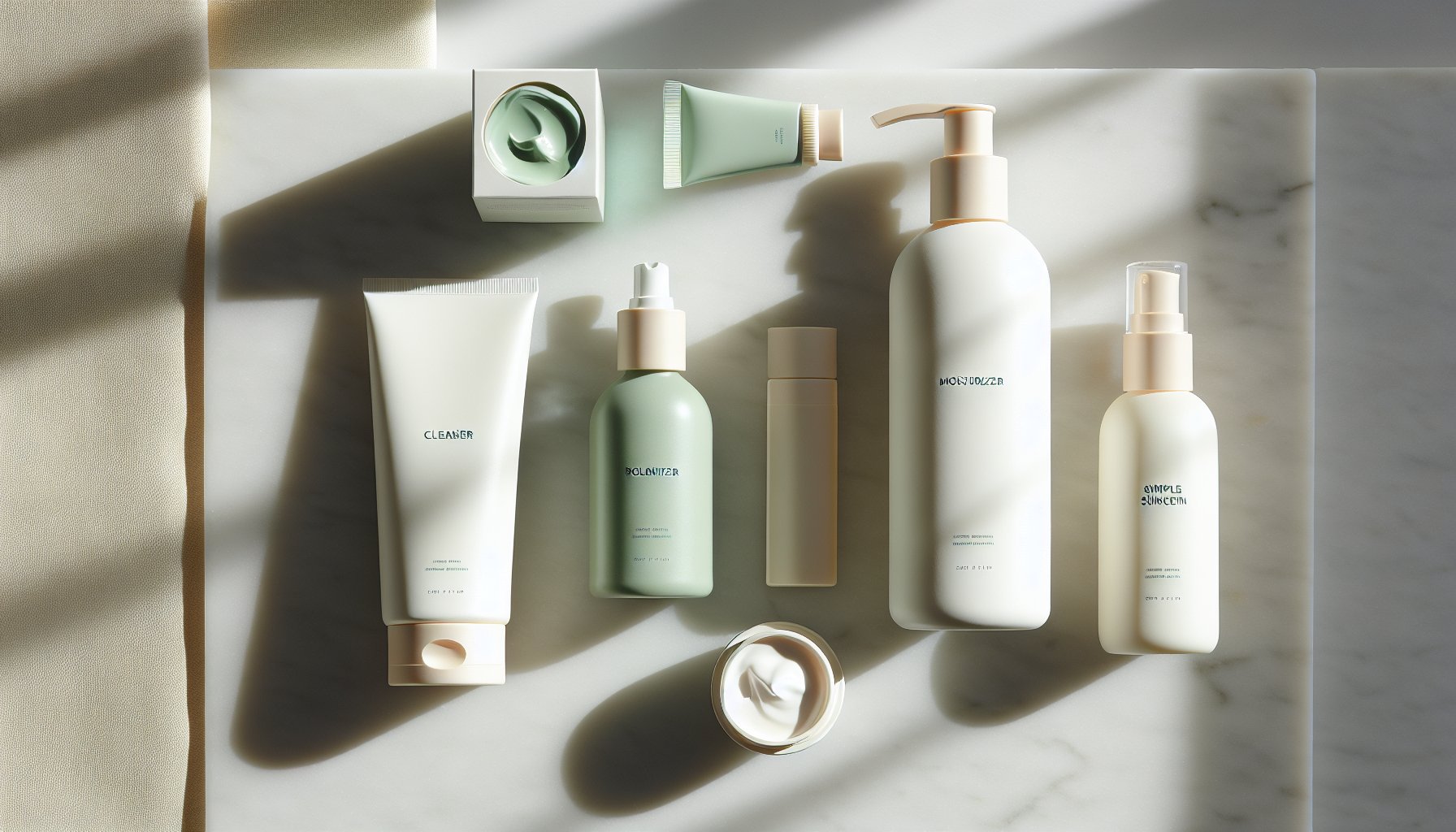
A cross-sectional study published in the Journal of Dermatological Treatment (2022) by Kim et al. found that over 80% of participants with healthy skin achieved their skin goals using a routine of just three products: cleanser, moisturizer, and sunscreen. Meanwhile, a survey by Goh et al. in the Journal of Cosmetic Dermatology (2023) found that multi-step routines with five or more products were associated with higher rates of self-reported skin sensitivity — suggesting that more products don't just fail to help, they can actively cause problems. The evidence points to a clear conclusion: a focused three-step routine outperforms the 10-step approach for most people.
Quick Summary:
- A cleanser, moisturizer, and sunscreen are the only three products the majority of people need for healthy, well-maintained skin
- Over 80% of visible skin aging is caused by UV exposure — making sunscreen the single highest-impact skincare product, not serums or treatments
- Multi-step routines increase the risk of irritation, barrier damage, and product interactions without proportional benefit for most skin types
- Adding one targeted active (like retinol or vitamin C) after establishing your three-step base makes sense for specific concerns — but it's an optional fourth step, not a requirement
- The best skincare routine is the one you'll actually do every day; consistency with three products beats sporadic use of ten
The Three Essential Steps
Step 1: Cleanser
Your cleanser's job is simple: remove dirt, oil, sunscreen, and environmental debris without stripping the skin barrier. That's it. A cleanser is on your face for 30-60 seconds before being rinsed off — it doesn't need active ingredients, anti-aging peptides, or exotic botanicals.
What to look for: A gentle, pH-balanced formula (pH 4.5-6.5) that doesn't leave your skin feeling tight or "squeaky clean" after rinsing. Tightness means the cleanser stripped your barrier lipids — the opposite of what healthy skin needs. See our pH guide for why cleanser pH matters.
CeraVe Hydrating Facial Cleanser (around $16) is a non-foaming, ceramide-containing formula that cleans effectively without disrupting the barrier. For oily skin that prefers a light lather, Vanicream Gentle Facial Cleanser (around $9) provides a mild foam without harsh sulfates.
Morning: A gentle cleanse to remove overnight oil and product residue. Some people with dry skin can skip the morning cleanser entirely and just rinse with water — this is fine.
Evening: A more thorough cleanse to remove sunscreen, makeup, and the day's buildup. If you wear heavy sunscreen or makeup, a double cleanse (oil-based cleanser first, then your regular cleanser) is more thorough than one pass.
Step 2: Moisturizer
Moisturizer maintains skin hydration by combining three types of ingredients: humectants (which attract water), emollients (which smooth and soften), and occlusives (which seal moisture in). This three-part approach prevents transepidermal water loss (TEWL) — the constant evaporation of water from the skin's surface that leads to dryness, flaking, and barrier compromise.
A study by Huang et al. published in the Journal of Clinical Medicine (2018) found that consistent moisturizer use improves skin barrier function measurably within two weeks, regardless of the specific brand or price point. The act of moisturizing matters more than the specific product.
What to look for: A formula containing at least one humectant (glycerin, hyaluronic acid), one emollient (ceramides, squalane), and one occlusive (dimethicone, petrolatum). CeraVe Moisturizing Cream (around $17) hits all three categories with ceramides, hyaluronic acid, and petrolatum. For oily skin, a lightweight gel moisturizer like Neutrogena Hydro Boost Water Gel (around $20) provides hydration without heaviness.
Morning and evening. Apply after cleansing (and after any serum, if you use one). Use enough to cover the entire face and neck without leaving a thick, unabsorbed layer.
Step 3: Sunscreen (Morning Only)
Sunscreen is the single most impactful product in any skincare routine. Research by Rodan et al. in the Journal of Drugs in Dermatology (2016) confirmed that up to 80% of visible facial aging — wrinkles, dark spots, loss of elasticity — is caused by UV exposure, not the passage of time. This means sunscreen prevents more aging than retinol, vitamin C, and peptides combined.
What to look for: SPF 30-50 broad-spectrum (protects against both UVA and UVB). Apply a quarter-teaspoon for the face — the "two finger-lengths" rule. See our how to apply sunscreen guide for the correct amount and technique, and our understanding SPF guide for what those numbers actually mean.
EltaMD UV Clear SPF 46 (around $39) is a lightweight, non-greasy formula containing niacinamide that works well on all skin types. For a budget option, Neutrogena Hydro Boost Water Gel Sunscreen SPF 50 (around $16) provides strong protection with a weightless finish.
Verdict: Cleanser, moisturizer, and sunscreen — that's the complete foundation. These three steps cleanse without damaging, hydrate without clogging, and protect against the primary cause of skin aging. Everything else is optional. If your skin is healthy and your concerns are minimal, this three-step routine is genuinely sufficient.
Why Minimalism Works
More Products Means More Risk
Every product you add introduces additional preservatives, fragrances, emulsifiers, and potential irritants. Goh et al. (2023) found that people using five or more daily products reported higher rates of skin sensitivity and irritation than those using fewer products. Each additional layer also increases the chance of ingredient interactions — active ingredients competing for absorption, conflicting pH levels, or destabilizing each other.
The Barrier Comes First
Your skin barrier is the foundation everything else depends on. A compromised barrier can't absorb active ingredients effectively, produces more oil to compensate for water loss, and triggers inflammation that worsens acne and redness. A simple, consistent routine protects the barrier rather than constantly challenging it with new products.
Consistency Beats Complexity
A three-step routine you do every morning and evening outperforms a ten-step routine you do sporadically. The primary determinant of skincare results is consistency over weeks and months — not the number of products or the price of your serum. See our results timeline guide for how long each type of ingredient takes to show results.
When to Add a Fourth Step
A minimalist routine handles prevention and maintenance. If you have a specific concern you want to actively treat, adding one targeted active ingredient makes sense — but only after your three-step foundation is established and working well (give it at least four weeks).
For aging, fine lines, and texture: Add a retinol serum at night, starting at a low concentration (0.025-0.05%) and building up. Retinol is the most evidence-backed anti-aging treatment available without a prescription.
For dark spots and uneven tone: Add a vitamin C serum in the morning. Vitamin C brightens, inhibits melanin production, and provides antioxidant protection that complements your sunscreen.
For acne and congestion: Add a salicylic acid treatment or benzoyl peroxide spot treatment. Start with one, not both — introducing multiple acne actives simultaneously overwhelms the skin.
For oiliness and pore appearance: Add a niacinamide serum (5-10%). It controls sebum, strengthens the barrier, and plays well with every other active ingredient.
The pattern: one targeted treatment added to the three-step base. Not three treatments. Not five. One.
Building Your Minimalist Routine by Skin Type
Dry skin:
- AM: Rinse with water → rich cream moisturizer → SPF 30-50
- PM: Gentle hydrating cleanser → rich cream moisturizer
Oily skin:
- AM: Gel or foaming cleanser → lightweight gel moisturizer → SPF 30-50
- PM: Gel or foaming cleanser → lightweight gel moisturizer
Combination skin:
- AM: Gentle cleanser → lightweight moisturizer → SPF 30-50
- PM: Gentle cleanser → lightweight moisturizer (or richer cream on dry areas)
Sensitive skin:
- AM: Fragrance-free gentle cleanser → fragrance-free moisturizer → mineral SPF 30-50
- PM: Fragrance-free gentle cleanser → fragrance-free moisturizer
For detailed recommendations for each skin type, see our guides for oily, dry, and combination skin.
Common Mistakes to Avoid
Adding products to fix problems caused by other products. If a serum causes dryness, the solution isn't adding a heavier moisturizer — it's reassessing whether you need that serum. Many "skin concerns" are actually reactions to overcomplicated routines.
Skipping moisturizer because your skin is oily. Oily skin still needs hydration. Skipping moisturizer increases TEWL, which signals the skin to produce more oil to compensate. A lightweight gel moisturizer reduces compensatory oil production, not increases it.
Using cleanser that makes your skin feel "clean." If your face feels tight, dry, or "squeaky" after cleansing, the cleanser is too harsh. Proper cleansing removes dirt and oil without stripping barrier lipids. Your face should feel comfortable, not stripped.
Treating sunscreen as optional. Sunscreen prevents more visible aging than every other skincare product combined. It's the one step you genuinely cannot skip if you care about your skin's long-term health and appearance.
Introducing multiple new products simultaneously. If you develop a reaction, you won't know which product caused it. Add one product at a time, wait two weeks, assess, then consider adding the next. See our introducing new products guide for the recommended protocol.
Frequently Asked Questions
Is a 3-step routine really enough?
For the majority of people with generally healthy skin, yes. Cleanser, moisturizer, and sunscreen address the three fundamentals: cleanliness, hydration, and UV protection. Active treatments are optional additions for specific concerns, not baseline requirements.
Don't I need a toner?
Most people don't. Toners were originally designed to remove cleanser residue from bar soap, which is no longer relevant with modern cleansers. Some hydrating toners provide a thin layer of additional hydration, but this function can be served by your moisturizer. A toner won't hurt, but it's not essential.
What about eye cream?
Eye creams are typically moisturizers with a smaller price-per-ounce. Your regular moisturizer can be gently patted around the eye area. The exception: if you want to treat specific under-eye concerns like dark circles with targeted ingredients (caffeine, retinol, vitamin K), a dedicated eye product uses lower, eye-safe concentrations.
Should I use a different routine in the morning and evening?
The core three steps are the same. The only differences: sunscreen is morning-only, and any treatment actives (retinol, exfoliating acids) are typically evening-only. Your cleanser and moisturizer can be the same products morning and night.
Can I just use water to wash my face?
In the morning, many people with dry or normal skin can rinse with water alone — this is fine. In the evening, you need a cleanser to remove sunscreen, oil, and environmental debris that water alone won't dissolve.
How long should a minimalist routine take?
About two to three minutes in the morning (cleanse, moisturize, sunscreen) and one to two minutes in the evening (cleanse, moisturize). If your routine takes longer than five minutes, it's no longer minimalist.
Is a minimalist routine cheaper?
Significantly. Three quality drugstore products (CeraVe cleanser at $16, CeraVe moisturizer at $17, and a $16 SPF) costs under $50 and lasts two to three months. A 10-step routine with serums, essences, masks, and treatments can easily cost $200-400 for the same period.
When should I upgrade from a minimalist routine?
When you have a specific, identified concern that three steps aren't addressing: persistent acne, noticeable hyperpigmentation, or visible fine lines you want to treat. Even then, "upgrading" means adding one targeted product — not overhauling everything.
Can a minimalist routine help with acne?
A gentle, barrier-supporting minimalist routine helps mild acne by reducing irritation and inflammation from overcleansing and over-treating. For moderate to severe acne, you'll likely need to add one treatment product (benzoyl peroxide or salicylic acid) as a fourth step, or see a dermatologist.
What if I enjoy a longer routine?
Skincare routines can be a form of self-care, and there's nothing wrong with enjoying the process. The minimalist argument is about efficacy, not pleasure. If you enjoy a multi-step routine and your skin tolerates it well, continue — just be aware that additional steps beyond the core three provide diminishing returns for skin health.
Do men need a different minimalist routine?
No. Skin physiology doesn't differ enough between genders to require different products. Men's skin tends to be slightly oilier and thicker on average, which may favor gel textures — but the three-step framework (cleanser, moisturizer, sunscreen) applies to everyone.
The Bottom Line
The most effective skincare routine for most people is the simplest: a gentle cleanser to keep skin clean without stripping it, a moisturizer to maintain hydration and barrier function, and a broad-spectrum sunscreen to prevent the UV damage responsible for 80% of visible aging. Master these three steps with consistency before adding anything else. The best routine isn't the longest — it's the one you do every single day.
Sources:
- Kim S, et al. "Simplified skincare routines and skin health outcomes: a cross-sectional analysis." Journal of Dermatological Treatment. 2022;33(4):1958-1964. https://pubmed.ncbi.nlm.nih.gov/32239984/
- Goh CL, et al. "Self-reported skin sensitivity and multi-step skincare routines: a population survey." Journal of Cosmetic Dermatology. 2023;22(1):232-240. https://pubmed.ncbi.nlm.nih.gov/36409588/
- Huang TH, et al. "Cosmetic and therapeutic applications of fish protein-derived moisturizers and skin barrier repair." Journal of Clinical Medicine. 2018;7(12):481. https://pmc.ncbi.nlm.nih.gov/articles/PMC6234074/
- Rajkumar J, et al. "Skin barrier function and moisturizer use: a clinical review." Dermatology and Therapy. 2023;13(9):1919-1937. https://pubmed.ncbi.nlm.nih.gov/37717558/
- Rodan K, et al. "Skincare bootcamp: the evolving role of skincare." Journal of Drugs in Dermatology. 2016;15(12 Suppl):s89-s94. https://pmc.ncbi.nlm.nih.gov/articles/PMC5172479/